Humanoid Robots Play Their First Full 11-vs-11 Soccer Match
At RoboCup 2026 in Incheon, the same two teams played each other twice on July 5 — a regulation five-a-side final, and hours later the first full 11-vs-11 humanoid soccer match on real hardware. The two scorelines measure different things.
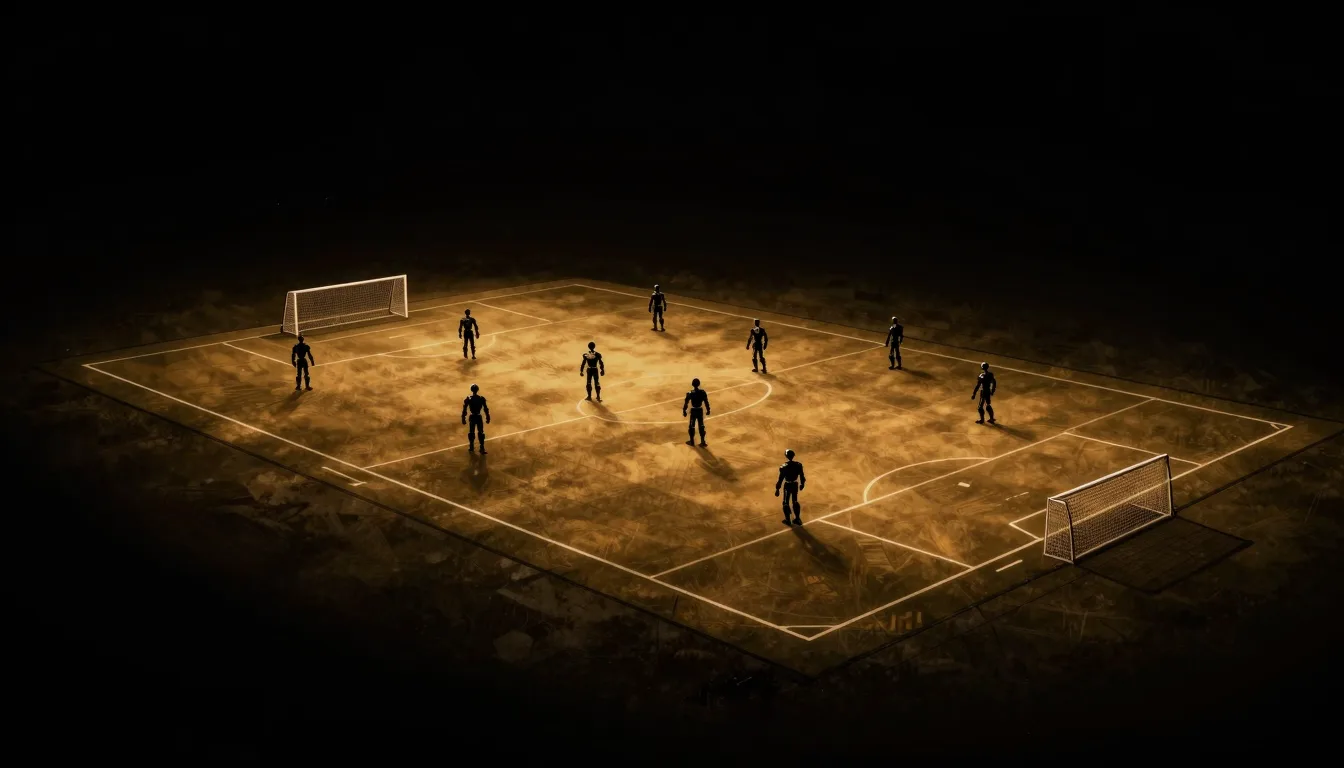
On July 5, 2026, at RoboCup's humanoid soccer finals in Incheon, South Korea, B-Human (University of Bremen and DFKI) beat HTWK Robots (Leipzig) twice on the same day, in two different formats, by two different scores. In the Middle Division championship, RoboCup's regulation format that caps rosters at up to five robots a side, B-Human won 6-0. Hours later, the same two teams fielded full squads of eleven humanoid robots each and played the first complete 11-vs-11 humanoid soccer match ever run on real hardware. B-Human won that one too, 4-0.
RoboCup 2026 ran June 30 to July 6 in Incheon, drawing robotics teams from dozens of countries across several leagues. In the Humanoid Soccer League, the Small, Middle and Large divisions were won respectively by Invic (Wuhan University), B-Human, and Tsinghua Hephaestus (Tsinghua University). The eleven-a-side match was not part of the official standings; it was staged separately, using the Middle Division's finalists as the two most capable teams on hand.
The two scores are not directly comparable, and that gap is the more informative part of the result. RoboCup's regulation Middle Division format keeps rosters small by design, because getting even three to five humanoid robots to track a ball, hold a formation, and recover from falls reliably is still difficult; a tighter format limits how much can go wrong on the field at once. Scaling to a full squad multiplies every failure mode simultaneously — more robots losing track of the ball, more collisions, more time spent standing back up — on top of the added problem of passing and marking across eleven players. A 4-0 result in that larger format arguably reflects a harder match than a 6-0 result in the smaller one.
Both squads competed on humanoid hardware built by Booster Robotics; B-Human's robots ran on the Booster K1 platform, with the team's own motion routines for running, shooting and recovering from falls trained through deep reinforcement learning and layered on top of the base hardware.
RoboCup Federation president Ubbo Visser said the match "shows how far humanoid robotics has come," adding that the newer hardware paired with a higher level of onboard intelligence "puts humanoid robot soccer on another level."
RoboCup was founded in 1997 around one explicit long-term target: that by 2050, a team of fully autonomous humanoid robots would beat that year's FIFA World Cup champions under official rules. The July 5 match did not resemble professional soccer — passing was tentative and positioning still looked closer to youth-league play than top-level football — but it was the first time the format itself, a full team on each side across a full match, existed on a field rather than only in that founding statement.